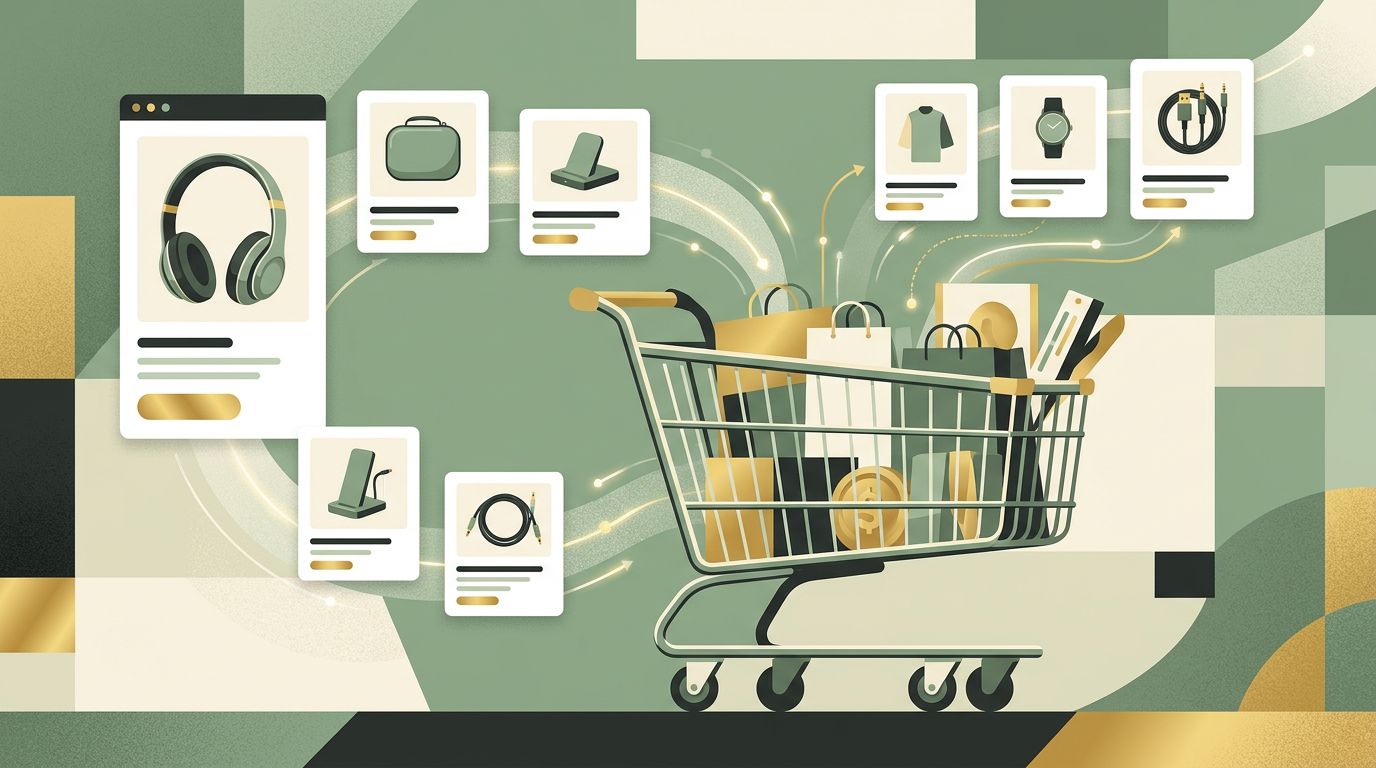
Quick take: AOV is one of the fastest revenue levers because it grows revenue without growing traffic. AI helps when it removes discovery friction, recommends relevant add-ons in the moment, and answers the questions that stop shoppers from buying the bigger basket.
Traffic keeps getting more expensive, which is why average order value, or AOV, matters so much. If you can generate more revenue from the same sessions, your acquisition costs become easier to carry and your store becomes more resilient.
The trap is thinking AOV goes up only when you raise prices. In practice, it usually goes up when you make it easier for shoppers to discover complementary products and buy with more confidence.
What AOV actually tells you
AOV is not just a finance metric. It is a signal about how well your store helps shoppers build a better cart.
| Low AOV often means | What is actually happening |
|---|---|
| Single-item carts dominate | Customers find one item but cannot see the complete solution |
| Cross-sells get ignored | Recommendations feel irrelevant or invisible |
| Premium variants underperform | Shoppers are not confident enough to choose the better option |
| Discovery is hard work | The store makes the shopper assemble the bundle alone |
The basic formula
The formula is simple:
Average order value = total revenue ÷ total number of orders
That is useful, but the real insight comes when you break it down. Look at AOV by landing page, by product category, by device, and by traffic source. A global number is helpful. A segmented number is actionable.
How to find AOV in Shopify
The exact Shopify reporting interface changes over time, but the principle stays the same: compare revenue and order count over the same time period in your analytics.
Once you have the number, do not stop there. Compare it across:
- new vs returning customers
- collection and product page entry points
- desktop vs mobile sessions
- assisted vs non-assisted shopping journeys
That is how you find where opportunity really sits.
Why AOV stalls on many Shopify stores
Stores often assume their AOV problem is a pricing problem. More often, it is a guidance problem.
Common causes:
- customers cannot see what goes together
- the premium option is not well explained
- collection pages do not help shoppers move from need to bundle
- buyers leave with unanswered compatibility or use-case questions
If the store makes the shopper do all the assembly work, the cart tends to stay small.
Five ways AI can lift AOV
| Tactic | Where it works | What it solves |
|---|---|---|
| Surface relevant add-ons in the moment | Product page, cart, post-add | Shoppers do not know what completes the purchase |
| Compare better, not sell harder | Product page, comparison view | Shoppers default to the cheaper option because the premium is not explained |
| Turn vague needs into bundles | Storefront chat, search | "I want a basic routine for dry skin" is a bundle prompt, not a SKU prompt |
| Reduce compatibility hesitation | Product page Q&A | "Will this work with what I already have?" stalls bigger carts |
| Recover discovery search misses | Storefront search and chat | Shoppers cannot find the second or third relevant item |
What to monitor after changes
After you introduce bundles, upsells, or shopping assistance, monitor more than AOV alone:
- conversion rate
- items per order
- assisted revenue share
- bundle attach rate
- pre-purchase questions answered before larger carts appear
You want higher AOV with healthy conversion, not higher AOV that comes from scaring away lower-intent shoppers.
Frequently asked questions
Should every store prioritize AOV?
Yes, but not in the same way. For some stores the biggest opportunity is bundles. For others it is better discovery, stronger product comparisons, or clearer product-page guidance.
Can AI improve AOV without aggressive upsells?
Yes. Some of the best gains come from better recommendations and clearer answers, not pushier selling. A shopper who buys two complementary items because the assistant explained the routine is worth more than a shopper pressured into a third item they will return.
What is the first thing to test?
Start where the cart naturally wants to expand: categories with complementary products, bundled routines, or high comparison behavior. Pre-purchase Q&A on the product page often shows results faster than storewide changes.
Does this only work for high-AOV stores?
No. Lower-AOV stores often see the biggest absolute % lift because there is more room to grow basket size. The mechanic is the same — fewer single-item carts, more multi-item carts.
If you want to fix the discovery side of the problem, read our article on AI search vs traditional search. For the product-page side, read about Shopify product page chatbots or our guide to Sidekick vs shopping assistants. To compare specific tools, start with our 2026 buyer's guide.
Explore Dori on Shopify if you want AI-guided recommendations, product comparisons, and cart-building support across the store.